
Indian pharmaceutical manufacturing is increasingly moving toward stronger quality systems, controlled manufacturing environments, documented processes, validation and risk-based quality management. Manufacturers operating in Baddi need to be aware of the current Schedule M framework when considering facility design, manufacturing operations, quality systems and regulatory readiness.
A revised schedule m plant in baddi should not be just a building with upgraded equipment. Schedule M lays down the Good Manufacturing Practices and requirements relating to the premises of the pharmaceutical, plant, equipment, quality systems, documentation and manufacturing controls. This framework is applicable for pharmaceutical manufacturers in India and Baddi is one of the important pharmaceutical manufacturing clusters in Himachal Pradesh.
This guide is for businesses that are considering a manufacturing partner, developing a new facility or upgrading an existing unit. It discusses Schedule M plant setup in baddi, major compliance considerations, GMP infrastructure, quality systems and what buyers should be looking for before they select a manufacturing facility.
What Is Revised Schedule M Plant in Baddi?
The Revised Schedule M Plant in Baddi is the updated Good Manufacturing Practices framework under the Drugs Rules in India. It gives requirements relating to pharmaceutical manufacturing premises, plant and equipment, quality systems, documentation, personnel, production, quality control and other manufacturing controls.
One of the main changes is the increased focus on a Pharmaceutical Quality System (PQS) and Quality Risk Management (QRM). Manufacturers should have documented systems that will ensure consistent product quality and minimize risks to the safety, quality or efficacy of pharmaceutical products.
Hence, Schedule M compliance is not only installation of modern machinery. A facility also needs the right procedures, qualified personnel, documentation, validation, quality control and robust systems to monitor and control manufacturing risks.
Revised Schedule M 2026: What Pharma Manufacturers Should Know
The term revised schedule m 2026 is being increasingly used by pharmaceutical companies seeking information about the current compliance position.
However, it is important to get the timeline right. The revised framework of Schedule M was notified vide G.S.R. 922(E) dated 28.12.2023. The implementation was phased based on manufacturer category. For eligible small and medium manufacturers with turnover up to ₹250 crore, an extension mechanism was provided later on, subject to the conditions mentioned in G.S.R. 127(E).
So, for companies that are contemplating compliance in 2026, the emphasis should be on the current implementation and proof of compliance and not on Revised Schedule M as a regulation that was introduced in 2026, new to the industry.
Manufacturers and buyers should consider:
- Status of manufacturing licence at present
- Relevant Schedule M requirements
- Facilities and equipment readiness
- Pharmaceutical Quality Systems
- Risk Management in Quality
- Qualification and validation
- Records and documentation
- Computerized systems where necessary.
- Quality control measures
- Training and Competency of Personnel
- Internal audits and corrective action
Key Requirements of a Schedule M Compliant Pharma Plant
A schedule m compliant pharma plant baddi should be designed and operated on the basis of suitable gmp principles. Specific requirements may differ depending on the products, dosage forms, manufacturing processes and applicable regulatory provisions.
These are key areas.
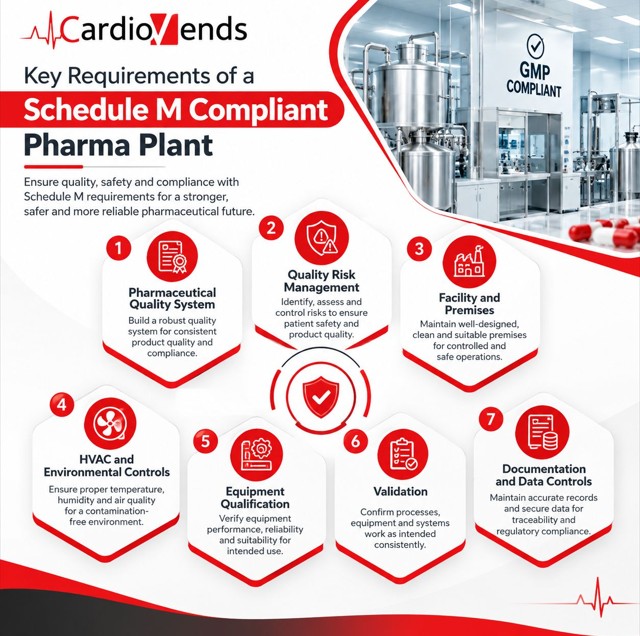
1. Pharmaceutical Quality System
The Pharmaceutical Quality System establishes the overall framework for the maintenance of product quality.
It should define appropriate responsibilities, procedures, controls, monitoring, review and continual improvement processes.
Senior management also has a key role in guaranteeing that the quality system is properly implemented and supported.
2. Quality Risk Management
Quality Risk Management enables manufacturers to identify, assess, control, communicate and review risks that can affect the quality of pharmaceuticals.
Therefore, a modern manufacturing facility should have documented risk-based approaches for relevant operations and quality decisions.
3. Facility and Premises
The physical design of a pharmaceutical manufacturing facility should facilitate orderly operations, cleaning, maintenance, material movement, personnel movement and contamination control.
Areas may include, depending on the manufacturing activity:
- Raw materials depot
- Sampling Locations
- Dispensing zones
- Rooms of production
- Packaging Areas.
- Finished Goods Inventory
- Laboratoires de contrôle de qualité
- Utility spaces
- Staff facilities
- Waste Handling Area
Facility design should be suitable to the products and processes being manufactured.
4. HVAC and Environmental Controls
HVAC systems are a critical part of pharmaceutical manufacturing as the quality of the product can be affected by the environment.
Depending on the manufacturing process, proper control of:
- Temperature
- Humidity
- Air movement
- Filtration Purity
- Air cleanliness
might be needed.
HVAC design should be viewed as part of the overall contamination-control and facility strategy, not simply as an equipment purchase.
5. Equipment Qualification
Production and laboratory equipment must be suitable for its intended use.
Qualification and calibration activities assist in demonstrating that equipment operates consistently within specified requirements.
The facility should have appropriate documentation for equipment installation, operation, performance, maintenance and calibration where applicable.
6. Validation
Validation provides documented evidence that a process, system, method or procedure, when applicable, is capable of consistently fulfilling predetermined requirements.
This can include reliance on the facility and manufacturing process:
- Process validation
- Validation Cleaning
- Validation of Analytical Method
- Validation of computerized systems
- qualification of usefulness
- Qualification of equipment
7. Documentation and Data Controls
Good documentation is critical in pharmaceutical manufacturing.
Manufacturers should keep suitable records to allow traceability and to facilitate investigation of manufacturing and quality activities.
Documentation can include:
- SOPs
- Batch Production Records
- Batch packing records
- Laboratory notes
- Equipment records
- Cleaning logs
- Training data
- Records of deviation
- CAPA logs
- Documentation for validation
Computerized systems used for GMP-related activities also require appropriate controls.
Schedule M Plant Setup in Baddi: What Does It Involve?
A proper schedule m plant setup in baddi requires planning beyond the construction of a production building.
The project should begin with an assessment of the intended products and manufacturing processes.
Step 1: Define the Manufacturing Scope
Before designing the facility, the manufacturer shall establish:
- Dosage forms
- Types of products
- Capacity to produce
- Production Process
- Packaging requirements
- Storage needs
- Quality control requirements
The facility should then be designed to meet these requirements.
Step 2: Develop a GMP-Based Facility Layout
The layout should support the logical movement of:
Raw Materials → Dispensing → Manufacturing → Packaging → Finished Goods
Consider personnel movement, material movement, waste movement and cross contamination risks.
Step 3: Plan Utilities
Identify critical utilities as per the manufacturing process.
They may be:
- HVAC
- Systems of purified water
- Air, compressed
- Electricals
- Temperature controlled storage
- Other utilities of some processes
Step 4: Install and Qualify Equipment
The selection of manufacturing equipment should be based on product and process requirements.
The installation must be followed by appropriate qualification and verification activities.
Step 5: Establish the Quality System
A facility requires documented systems for production, quality control, deviations, corrective and preventive action (CAPA), change control, training, documentation, complaints, recalls, and other applicable GMP activities.
Step 6: Conduct Compliance Assessment
The manufacturer should identify the gaps and do appropriate internal reviews to correct prior to commercial operations.
Revised Schedule M GMP Facility Baddi: What Should Buyers Check?
The businesses that are looking for a revised schedule m gmp facility baddi are not necessarily looking for a manufacturing building only. They want to see evidence that the facility can make pharmaceuticals reliably.
Look for the following before you select a manufacturing partner:
| Area | What to Verify |
|---|---|
| Manufacturing Licence | Applicable licence and product scope |
| Schedule M | Applicable compliance status |
| GMP Certification | Certificate scope and validity |
| Manufacturing Sections | Whether your dosage form is covered |
| Quality Control | Laboratory and testing capabilities |
| Quality System | PQS, deviations, CAPA and change control |
| Validation | Relevant qualification and validation records |
| Documentation | Batch and quality documentation |
| Storage | Raw material and finished goods controls |
| Production | Capacity and manufacturing capability |
| Quality History | Relevant regulatory and quality information |
| Supply | Production planning and delivery capabilities |
Don’t choose a manufacturing partner based solely on a certificate or marketing statement. The scope of the facility, the relevant licences, manufacturing sections and supporting quality documentation should also be considered.
GMP Plant Setup in India: How Baddi Fits Into the Larger Market
The setup a gmp plant in india should be compliant to the national pharmaceutical regulations and specific requirements of the manufacturing activity to be undertaken.
Baddi is relevant due to its established pharmaceutical manufacturing ecosystem and concentration of industrial and supporting infrastructure.
However, location alone does not mean GMP compliance.
A pharmaceutical buyer should consider the individual manufacturing site, and not assume that all facilities in a pharmaceutical cluster are held to the same standards.
Therefore, the companies comparing manufacturers in Baddi should consider the facility’s:
- Scope of manufacture
- Quality Systems
- Regulatory documentations
- Production capacity
- Infrastructure for Quality Control
- Product specific experience
- Documentation practices
- Supply Capabilities
Benefits of Working With a Schedule M-Oriented Manufacturing Facility
Choosing the right compliant manufacturing partner can help pharma businesses achieve better quality management and structured production.
Benefits may include:
Consistent Manufacturing Processes
Documented procedures and controlled manufacturing processes can help to ensure consistency between the batches
Better Quality Management
A structured quality system has mechanisms to investigate deviations, manage changes and execute corrective and preventive actions.
Stronger Documentation
Good documentation makes it easy to track manufacturing activities and supports investigations, when necessary.
Improved Supplier Evaluation
Regulatory status, scope of the facility, quality systems and manufacturing capabilities review, enables companies to make more informed manufacturing decisions.
Support for Long-Term Manufacturing
A well-run facility can be a more solid foundation for contract manufacturing, private-label production and other B2B pharmaceutical needs.
How to Choose a Schedule M Compliant Pharma Plant in Baddi?
When evaluating a schedule m compliant pharma plant baddi, businesses should use a structured checklist instead of relying only on promotional claims.
1. Check the Manufacturing Scope
Start by confirming the facility actually manufactures the dosage form and product category you need. Not every unit handling similar-sounding products will match your exact requirement, so this has to be checked first, not assumed.
2. Review Regulatory Documentation
Ask for the licences, certificates, approvals, and supporting documents tied to that specific manufacturing activity. Paperwork that looks impressive on a website isn’t the same as documentation that covers your product.
3. Evaluate the Quality System
Find out how the manufacturer actually handles deviations, CAPA, change control, complaints, recalls, validation, and documentation. This is where a lot of plants fall short in practice, even when they look compliant on paper.
4. Check Manufacturing Capacity
Check whether the facility can genuinely support your expected order volumes and production timelines — capacity on a brochure doesn’t always hold up once real orders come in.
5. Evaluate Quality Control
A solid quality control system matters too, since it’s what tests raw materials, in-process materials, finished products, and other applicable samples along the way.
6. Review Packaging Capabilities
Packaging needs attention as well. It has to protect product quality and meet the requirements specific to your product, not just look presentable.
7. Discuss Supply and Communication
For B2B pharmaceutical businesses, timely communication, production planning, documentation, and supply coordination are important considerations.
Revised Schedule M vs. Conventional GMP Facility in Baddi
A conventional GMP facility doesn’t automatically meet every Revised Schedule M requirement. The revised framework leans harder on pharmaceutical quality systems, risk management, validation, documentation and tightly controlled manufacturing. So when checking schedule m plant compliance baddi himachal pradesh, look at the manufacturing licence, the regulatory requirements that apply, the quality control procedures and the compliance records behind them. What counts is how the plant actually implements those requirements. Its location or newer equipment doesn’t settle it.
Why Schedule M Compliance Matters for Third-Party Manufacturing?
Schedule M compliance matters when you choose a third-party pharmaceutical manufacturer. Its quality systems, production controls and documentation habits directly shape product quality, batch consistency and whether your supply shows up on time.
Before signing a manufacturing agreement, pharma entrepreneurs and brand owners should:
- Verify the manufacturing licence: Make sure it covers your products and dosage forms.
- Review quality systems: Ask how deviations, corrective and preventive actions (CAPA) and change control are handled.
- Check validation and documentation: Look at equipment qualification, process validation and batch manufacturing records.
- Assess production capacity: Confirm they can handle your expected volumes and delivery dates.
- Evaluate quality control: See which testing capabilities and procedures apply to your products.
A careful evaluation lowers manufacturing risk and leads to steadier long-term partnerships.
Revised Schedule M Compliance Checklist for Pharma Buyers
Before you pick a pharmaceutical manufacturing facility in Baddi, run it through this checklist to see whether it fits your business needs.
| Compliance area | What to verify |
|---|---|
| Manufacturing licence | Valid licence and relevant product scope |
| Schedule M compliance | Applicable requirements and supporting evidence |
| Facility and equipment | Suitability for the intended manufacturing processes |
| Quality management | Pharmaceutical Quality System and risk management procedures |
| Validation | Equipment qualification and process validation records |
| Documentation | Batch records, SOPs, deviation records and CAPA documentation |
| Quality control | Suitable testing facilities and quality procedures |
| Production and supply | Manufacturing capacity, timelines and supply coordination |
Cardio Vends and Pharmaceutical Manufacturing
Cardio Vends supports B2B business opportunities in cardiac and diabetic pharmaceuticals. If you’re exploring manufacturing partnerships, judge each facility against your product requirements, manufacturing capabilities, quality systems and regulatory documents. Before you finalize a partner, verify its licences and compliance evidence yourself.
Looking for cardiac and diabetic pharmaceutical manufacturing opportunities? Connect with Cardio Vends to discuss your product requirements and explore suitable business opportunities.
Frequently Asked Questions
What is Revised Schedule M?
It’s the updated GMP framework under India’s Drugs Rules for pharmaceutical manufacturing — covering premises, plant, equipment, quality systems, and how manufacturing itself gets controlled.
Is Revised Schedule M applicable to pharma plants in Baddi?
Yes. Schedule M applies nationwide, so it doesn’t matter that a plant sits in Baddi — it still has to meet the requirements tied to whatever it manufactures, the licences it holds, and the facility it runs.
What is required for a Schedule M plant setup in Baddi?
You need the right premises, equipment, utilities, and manufacturing controls, backed by proper quality systems, documentation, trained personnel, and validation. What exactly that looks like shifts depending on the products and the manufacturing activity involved.
What is a Schedule M compliant pharma plant?
It’s a site that actually meets Schedule M’s requirements — not just on paper, but with records, systems, and controls that show the implementation is real and ongoing.
Does GMP certification automatically mean Revised Schedule M compliance?
No, not automatically. A generic GMP claim doesn’t guarantee full Schedule M coverage — buyers need to actually check the certificate, the manufacturing licence, its scope, and the facility documentation behind it.
Why is Baddi important for pharmaceutical manufacturing?
Baddi, in Himachal Pradesh, is one of India’s established pharma clusters. The concentration of manufacturers there and the surrounding industrial ecosystem make it a genuinely important hub for both manufacturing and B2B pharma work.
What should pharma buyers verify before selecting a Baddi manufacturer?
Check the licence, the product scope, and the quality systems — then go further into the GMP/Schedule M paperwork, manufacturing capacity, QC capabilities, validation, documentation, and whether their supply capability actually matches what you need.
