
Category: Blogs

Blogs

Top 10 Own Manufacturing PCD Companies in India | Cardiovends

Top 10 Own Manufacturing PCD Companies in India

Top Own Manufacturing PCD Companies in India include names like CardioVends, Zenova Life Sciences, and MedGrace Pharma. These companies manufacture their own range of products and operate WHO-GMP/ISO-certified plants and do not outsource to third parties but provide franchise rights on a monopoly basis. This gives franchise partners tighter quality control, faster delivery, and higher margins. Table of Contents Introduction to Own Manufacturing PCD Companies Top 10 Own Manufacturing PCD Companies in India Comparison Table — Top 10 PCD Companies at a Glance Why Choose Own Manufacturing PCD Companies in India? Manufacturing Processes Followed by Own Manufacturing Pharma Companies How to Choose the Best Own-Manufacturing Pharma Company Benefits of Choosing a Company with Own Manufacturing Unit Essential Requirements to Start Your Own Manufacturing PCD Company Why Cardio Vends is a Trusted Platform for Finding One's Own Manufacturing PCD Companies in India Conclusion—Choosing the Best Own Manufacturing PCD Company Frequently Asked Questions Introduction of Own Manufacturing PCD Companies Own manufacturing PCD Company An own manufacturing PCD company is a pharmaceutical company which manufactures their own medicines in a dedicated, in-house facility and does not outsource production to third party loan licensees. That’s a distinction that matters a lot more to a franchise seeker than most marketing materials would have you believe. When a company produces its own product it controls three of the most important things a franchise partner cares about: batch quality, supply timelines and price stability. A pcd pharma with own manufacturing setup can adjust production schedules, run quality checks in-house, and avoid the delays that come from depending on an external manufacturer's capacity. This is the reason why the searches for own manufacturing pcd company and own manufacturing pharma franchise in india have been growing steadily – franchise partners have learned, sometimes the hard way, that "PCD company" and "manufacturer" are not always the same. Top 10 Own Manufacturing PCD Companies in India Here is a sorted list of companies which qualify as a real own manufacturing pharma franchise company – WHO-GMP/ISO certified plants, transparent product portfolio and monopoly based distribution model. 1. CardioVends — Own Manufacturing, Monopoly-Based Franchise CardioVends has its own WHO-GMP and ISO Certified Manufacturing Unit for cardiac, diabetic and general range formulations. It is a Pcd pharma company with own manufacturing unit, Providing transparent Monopoly rights in most of the Indian states. Established: Modern manufacturer (see company for year) GMP/ISO Certification: WHO-GMP & ISO Certified Plant Product Segments: Cardiac, Diabetic, General Range, Nutraceuticals States Covered: State-wise monopoly across India Minimum Order: MOQ will be decided by the company post on-boarding. 2. Zenova Life Sciences — Full-Spectrum Own Manufacturing Zenova is a fully integrated own manufacturing pcd company with its own production lines for tablets, capsules and syrups. Founded: Mid-2010s (check with company) GMP/ISO Status WHO-GMP Product Segments : General, antibiotics, derma. States Covered : North & Central India monopoly areas Minimum Order : Medium Min. Qty. 3. MedGrace Pharma — Derma & Cosmeceutical Manufacturing MedGrace is aimed to niche franchisees and is focused on derma and cosmeceutical own manufacturing. Founded: Founded in the 2010s GMP/ISO Status: ISO 9001 certified Product Segments: Derma, cosmeceuticals, wellness States Covered: Western & Southern India Minimum Order: Low to Mid MOQs 4. Vitalcure Formulations — Critical Care Own Manufacturing Vitalcure focuses on critical care and injectable own manufacturing with strict batch-testing protocols. Founded: Established late 2000s GMP/ISO Status: Certified by WHO-GMP Product Segments: Injectables, critical care, orthopedics States Covered : Whole of India Minimum Order: Higher MOQ (injectable specific) 5. Panacea Biotrust — General Range Own Manufacturing Panacea Biotrust is a leading range manufacturing company. It is one of the most popular companies among first time seekers of PCD Franchise. Founded: Early 2000s GMP/ISO Status: Certified by WHO-GMP Product Segments Tablets Capsules Syrups Ointments States Covered Pan India Monopsonistic model Entry level MOQ Minimum Order Quantity 6. Trumed Healthcare — Pediatric & Gynae Own Manufacturing Trumed’s in-house facility is specialized in paediatric and gynae range which is a growing niche in PCD segment. Founded: 2010s GMP/ISO Status: ISO Certification Product Segments: Paediatric, gynae, nutraceutical States Covered: North & East India Minimum Order: Mid range MOQ 7. Neurogenix Pharma — Neuro & Psychiatry Own Manufacturing Neurogenix has its own manufacturing unit dedicated for neuro and psychiatry formulations. Established: 2010s GMP/ISO Status: WHO-GMP Certification Product segments: Neuro, psych, pain management. States Included: Metro-centric monopoly areas Minimum Order: Mid-range MOQ 8. Ortholine Remedies — Ortho & Pain Management Manufacturing Ortho and pain-management formulations produced at scale in Ortholine’s own production facility. Founded: Mid 2000s founded GMP/ISO Status WHO-GMP certified Product Segments Orthopedics, pain management, physiotherapy support States Covered All India Minimum Order: Mid-high MOQ 9. Purelife Biotech — Nutraceutical Own Manufacturing Purelife focuses on nutraceuticals and wellness products manufactured in its own facility. Founded: Established 2010s GMP/ISO Status: ISO 22000 & GMP certified Product Segments: Nutraceuticals, protein supplements, wellness States Covered: Pan-India Minimum Order: Low MOQ 10. Genwell Pharmaceuticals — Antibiotic & General Range Manufacturing Genwell completes the list with its own antibiotic and general-range manufacturing facilities. Founded: 2000’s GMP/ISO Status WHO-GMP certified Product Segments Antibiotics, general range, anti-inflammatory States Pan-India Minimum Order : MOQ in Mid Range Comparison Table — Top 10 PCD Companies at a Glance # Company Est. Year* Certifications* Product Range Monopoly Rating* 1 CardioVends Verify WHO-GMP, ISO Cardiac, Diabetic, General Yes 4.6/5 2 Zenova Life Sciences Verify WHO-GMP General, Antibiotics, Derma Yes 4.4/5 3 MedGrace Pharma Verify ISO 9001 Derma, Cosmeceuticals Yes 4.3/5 4 Vitalcure Formulations Verify WHO-GMP Injectables, Critical Care Yes 4.5/5 5 Panacea Biotrust Verify WHO-GMP General Range Yes 4.2/5 6 Trumed Healthcare Verify ISO Pediatric, Gynae Yes 4.3/5 7 Neurogenix Pharma Verify WHO-GMP Neuro, Psychiatry Yes 4.4/5 8 Ortholine Remedies Verify WHO-GMP Ortho, Pain Management Yes 4.2/5 9 Purelife Biotech Verify ISO 22000, GMP Nutraceuticals Yes 4.3/5 10 Genwell Pharmaceuticals Verify WHO-GMP Antibiotics, General Yes 4.1/5 Why Choose Own Manufacturing PCD Companies in India? If you’re planning to start or expand a pharma franchise, the manufacturer you choose to work with matters more than most people realize in the beginning. This is exactly why so many distributors actively look for the best own-manufacturing PCD companies in India—because when a company makes its own products, you’re not dealing with a middleman who has no real control over what’s being produced. Better Product Quality Control Here’s the thing about outsourced manufacturing—you’re trusting someone else’s factory, someone else’s process, and someone else’s quality checks. Companies that manufacture in-house don’t have that problem. They own the production line, so they can catch issues early, maintain consistency batch after batch, and actually stand behind what they’re selling. That’s a big reason Top Own Manufacturing PCD Companies in India tend to earn more trust from franchise partners over time. Cost-Effective Manufacturing Cutting out third-party manufacturers also cuts out extra costs. No middleman markup, no negotiating with an external unit for better rates — just a direct line from production to pricing. This is why partnering with leading own-manufacturing PCD companies in India often works out cheaper for franchise owners, without them having to compromise on what they’re actually selling. Timely Product Availability Ask anyone running a pharma franchise what frustrates them most, and stock delays will come up almost every time. When a company controls its own manufacturing, it also controls its own timelines. Orders move faster, restocking is smoother, and franchise partners aren’t left waiting around wondering when the next shipment will show up. Strong Brand Value There’s also something to be said about reputation. A company that manufactures its own products is putting its name directly on the line every single time. Over the years, that builds a kind of credibility that outsourced brands struggle to match — and that credibility eventually rubs off on every franchise partner carrying their products. Manufacturing Processes Followed by Own Manufacturing Pharma Companies So what actually happens behind the scenes at these companies? It’s a fairly structured process, even if it looks simple from the outside. Research & Development Everything starts from the research & development laboratory. The top pharmaceutical manufacturers in India invest both their efforts and resources into formulating and perfecting their products according to the demands of the market and not the feasibility of production alone. Raw Material Procurement Next comes sourcing. Good manufacturers don’t cut corners here, because raw material quality basically decides the fate of the final product. They work with certified, reliable suppliers and run checks before anything even enters the production line. Production Process This is the stage where the real formulation work happens. Raw materials get mixed, processed, and turned into the actual product, and all of it happens under GMP-compliant conditions — nothing is left to chance. The staff running these lines are trained specifically for this, and the machinery is regularly calibrated, because even a slight deviation at this point can throw off an entire batch. There’s really no room for shortcuts here. Quality Testing Any unit that leaves the factory is tested for purity, stability, potency, and safety. The Testing of medicines is considered by Leading Pharma Companies in India to be mandatory, because this is the last resort before any drug gets into the hands of a customer. How to Choose the Best Own Manufacturing Pharma Company Before you join any own manufacturing pharma franchise company, verify these points directly: Ask for the manufacturing license and GMP/ISO certificate – not just a website claim. Where possible, especially for high order volume commitments, visit or request a virtual tour of the plant. How big is your product portfolio in relation to your target therapeutic segment? If you want true exclusivity, confirm your monopoly boundaries in writing — at the district level, not just the state level. Review promotional input support (visual aids, samples, MR bags) given on monthly or quarterly basis. Compare minimum order quantity (MOQ) with your initial capital. Request references from current franchisees in your region Benefits of Choosing a Company with Own Manufacturing Unit Selecting a pharma company with own manufacturing unit changes the economics and reliability of a PCD franchise in three concrete ways. Quality Control & Consistency Having your own plant means every batch goes through the same quality control team, the same raw material sourcing process, and the same testing standards. You don’t have to worry about variability from third-party manufacturers, which is important when the reputation of your franchise depends on consistent product quality. Faster Order Fulfillment Companies that make their own products don’t have to wait in line behind someone else’s production schedule. Orders move faster from confirmation to dispatch as the company controls its own production calendar, a key advantage in seasonal demand surges (for example monsoon related demand for antibiotics). Better Margins for Franchise Partners Own-manufacturing companies can generally provide better pricing to franchise partners by removing the margin layer of the manufacturer. Which means: Lower manufacturing cost More pricing power in retail Franchise holder net margin retention higher Less reliance on price renegotiations during the contract period Essential Requirements to Start Your Own Manufacturing PCD Company Drug Licenses and GST Registration Obtain a valid wholesale and manufacturing drug license from the corresponding regional authorities. Also, you need to register for GST to comply with national requirements. All required documents give your business legal rights to operate in this region. You can deliver products across state borders as one of the rising own manufacturing PCD company in India. WHO-GMP Certified Manufacturing Plant As in any other business related to health care products, it is important to manufacture medicines safely. For this reason, you should follow the standards prescribed in the latest schedule M. It will give your products international credibility and increase your chances of attracting franchisees and selling your medicines overseas. Moreover, it will provide you more confidence regarding the product’s safety. Financial Planning and Capital Investment The total investment amount may vary from ₹20 lakhs to ₹35 lakhs for a medium-sized company. However, it is recommended to leave enough money in your business account to cover various expenses. Thus, you can create a stable foundation for your pharma franchise own manufacturing company. Product Range and Trademark Registration As you see, establishing your own manufacturing business means choosing a particular therapeutic range to manufacture. You can choose the products based on consumer preferences and the needs of the Indian market. Moreover, it is crucial to register your trademark to protect your business against copying. Marketing Strategy and Franchise Partners As previously mentioned, it is important to choose your franchise partners wisely. Therefore, you can develop a marketing strategy focusing on motivating your partners and helping them to attract more customers. You can provide them with various promotional aids, such as visuals or a catch cover. This will boost their marketing campaign. Why Cardio Vends is a Trusted Platform for Finding One’s Own Manufacturing PCD Companies in India With so many manufacturers claiming to be “the best,” how do you actually separate the genuine ones from the rest? That’s the problem Cardio Vends was built to solve. Verified Manufacturing Partners Every company listed goes through a verification process — checking licenses, certifications, and manufacturing compliance — so franchise seekers aren’t left guessing whether a company is legitimate. Quality-Focused Network It is not just the case that Cardio Vends just adds companies into its database just to increase the number of listings. Instead, the platform emphasizes manufacturers who care about quality, hence providing the user with the ability to find reliable Own Manufacturing PCD Companies in India. Wide Product Portfolio Whether someone’s looking for cardiac ranges, general medicines, or something more specialized, the platform brings together a variety of manufacturers, giving franchise partners the flexibility to pick what actually fits their market. Transparent Business Support And possibly most importantly, there is clarity on the way information is delivered. It’s clear in everything from company details to product lines to credentials, enabling decision-making without any need for doubt. Conclusion—Choosing the Best Own Manufacturing PCD Company A true pcd company with real own manufacturing vs one that just out-sources production becomes apparent months into a franchise partnership – in delayed stock, inconsistent batches, or shrinking margins. The kind of in-house manufacturing model that keeps those risks away from franchise partners is exemplified by companies like CardioVends, and the others mentioned here. Get your certifications in order, visit the plant if you can and get your monopoly terms in writing before you sign on the dotted line. A few more weeks of upfront due diligence can save years of operational friction down the line. Frequently Asked Questions Q1. What are some examples of Own Manufacturing PCD Companies in India? Examples include companies such as CardioVends, Zenova Life Sciences and MedGrace Pharma – companies that operate their own WHO-GMP/ISO certified plants rather than outsource production. Please check with each company for up to date certifications and product ranges before you commit. Q2. Why are Own Manufacturing PCD Companies superior to other types of PCD Companies? Own manufacturing companies have direct control over production quality, delivery times and pricing, without dependence on the capacity or schedule of a third-party manufacturer. That usually means more consistent batch quality, faster order turnarounds and better margins for franchise partners. Q3. What do you mean by PCD Companies Offering Unique Products? These are PCD companies who make niche, differentiated or hard-to-find formulations – like specialized nutraceutical combinations or unique drug delivery formats – and so franchise partners get a competitive edge over generic, widely-available product lines in their local market. Q4. What is the difference between a PCD company and an own manufacturing company? A typical PCD company may outsource its production to third-party manufacturers, under loan-license arrangements, while an own manufacturing company manufactures its own products in-house. The latter tends to have better quality control and more reliable delivery schedules. Q5. Which PCD pharma company has its own manufacturing plant in India? CardioVends and some of the other WHO-GMP/ISO certified manufacturers listed above have their own manufacturing facilities. Always check with the company directly for the current plant ownership and certification status as this may change over time. Q6. How do I find the best own manufacturing PCD Companies in India? Honestly, the very first thing that you need to check is whether the company really owns its manufacturing unit and not just claims to. You can check for GMP and WHO-GMP certifications to be sure. It also helps to check their product range and how upfront they are about sharing licenses and quality documents when asked. This is where a platform like Cardio Vends can be very handy, as it has a list of checked and approved manufacturers. Most Searched at CardioVends Regarding own manufacturing PCD franchise own manufacturing PCD companies in India. own manufacturing PCD company best own-manufacturing PCD companies in India top own-manufacturing PCD companies in India leading own-manufacturing PCD companies in India pharma franchise own manufacturing company.

April 13th, 2026

Read More

Revised Schedule M Plant in Baddi: GMP Compliance Guide 2026 | Cardiovends

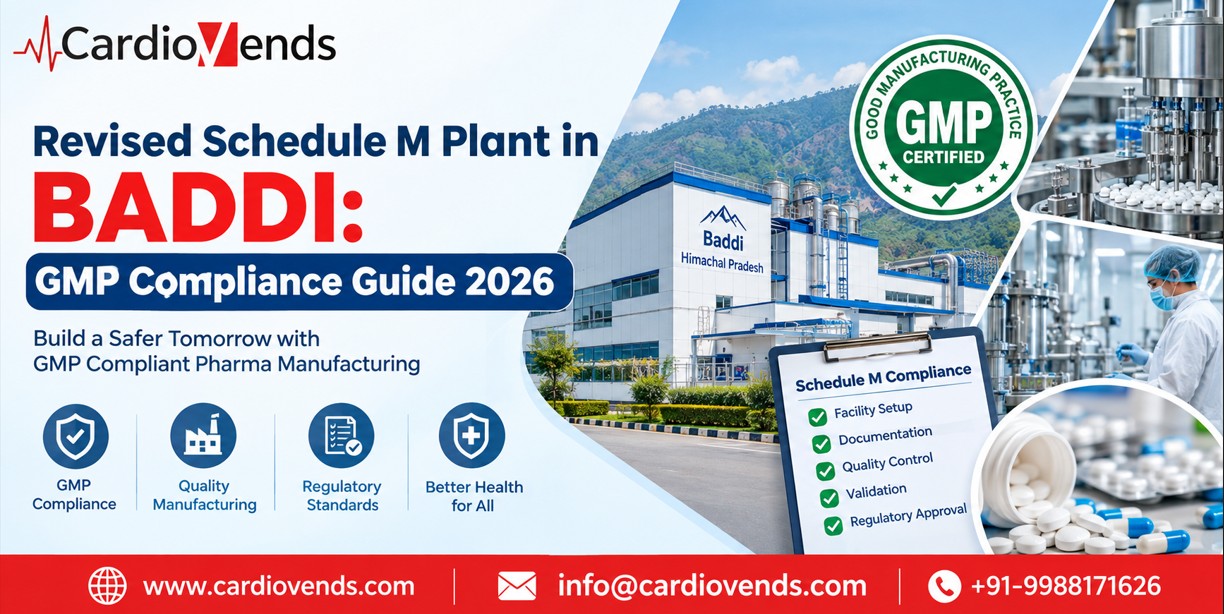
Revised Schedule M Plant in Baddi: GMP Compliance Guide 2026

Indian pharmaceutical manufacturing is increasingly moving toward stronger quality systems, controlled manufacturing environments, documented processes, validation and risk-based quality management. Manufacturers operating in Baddi need to be aware of the current Schedule M framework when considering facility design, manufacturing operations, quality systems and regulatory readiness. A revised schedule m plant in baddi should not be just a building with upgraded equipment. Schedule M lays down the Good Manufacturing Practices and requirements relating to the premises of the pharmaceutical, plant, equipment, quality systems, documentation and manufacturing controls. This framework is applicable for pharmaceutical manufacturers in India and Baddi is one of the important pharmaceutical manufacturing clusters in Himachal Pradesh. This guide is for businesses that are considering a manufacturing partner, developing a new facility or upgrading an existing unit. It discusses Schedule M plant setup in baddi, major compliance considerations, GMP infrastructure, quality systems and what buyers should be looking for before they select a manufacturing facility. What Is Revised Schedule M Plant in Baddi? The Revised Schedule M Plant in Baddi is the updated Good Manufacturing Practices framework under the Drugs Rules in India. It gives requirements relating to pharmaceutical manufacturing premises, plant and equipment, quality systems, documentation, personnel, production, quality control and other manufacturing controls. One of the main changes is the increased focus on a Pharmaceutical Quality System (PQS) and Quality Risk Management (QRM). Manufacturers should have documented systems that will ensure consistent product quality and minimize risks to the safety, quality or efficacy of pharmaceutical products. Hence, Schedule M compliance is not only installation of modern machinery. A facility also needs the right procedures, qualified personnel, documentation, validation, quality control and robust systems to monitor and control manufacturing risks. Revised Schedule M 2026: What Pharma Manufacturers Should Know The term revised schedule m 2026 is being increasingly used by pharmaceutical companies seeking information about the current compliance position. However, it is important to get the timeline right. The revised framework of Schedule M was notified vide G.S.R. 922(E) dated 28.12.2023. The implementation was phased based on manufacturer category. For eligible small and medium manufacturers with turnover up to ₹250 crore, an extension mechanism was provided later on, subject to the conditions mentioned in G.S.R. 127(E). So, for companies that are contemplating compliance in 2026, the emphasis should be on the current implementation and proof of compliance and not on Revised Schedule M as a regulation that was introduced in 2026, new to the industry. Manufacturers and buyers should consider: Status of manufacturing licence at present Relevant Schedule M requirements Facilities and equipment readiness Pharmaceutical Quality Systems Risk Management in Quality Qualification and validation Records and documentation Computerized systems where necessary. Quality control measures Training and Competency of Personnel Internal audits and corrective action Key Requirements of a Schedule M Compliant Pharma Plant A schedule m compliant pharma plant baddi should be designed and operated on the basis of suitable gmp principles. Specific requirements may differ depending on the products, dosage forms, manufacturing processes and applicable regulatory provisions. These are key areas. 1. Pharmaceutical Quality System The Pharmaceutical Quality System establishes the overall framework for the maintenance of product quality. It should define appropriate responsibilities, procedures, controls, monitoring, review and continual improvement processes. Senior management also has a key role in guaranteeing that the quality system is properly implemented and supported. 2. Quality Risk Management Quality Risk Management enables manufacturers to identify, assess, control, communicate and review risks that can affect the quality of pharmaceuticals. Therefore, a modern manufacturing facility should have documented risk-based approaches for relevant operations and quality decisions. 3. Facility and Premises The physical design of a pharmaceutical manufacturing facility should facilitate orderly operations, cleaning, maintenance, material movement, personnel movement and contamination control. Areas may include, depending on the manufacturing activity: Raw materials depot Sampling Locations Dispensing zones Rooms of production Packaging Areas. Finished Goods Inventory Laboratoires de contrôle de qualité Utility spaces Staff facilities Waste Handling Area Facility design should be suitable to the products and processes being manufactured. 4. HVAC and Environmental Controls HVAC systems are a critical part of pharmaceutical manufacturing as the quality of the product can be affected by the environment. Depending on the manufacturing process, proper control of: Temperature Humidity Air movement Filtration Purity Air cleanliness might be needed. HVAC design should be viewed as part of the overall contamination-control and facility strategy, not simply as an equipment purchase. 5. Equipment Qualification Production and laboratory equipment must be suitable for its intended use. Qualification and calibration activities assist in demonstrating that equipment operates consistently within specified requirements. The facility should have appropriate documentation for equipment installation, operation, performance, maintenance and calibration where applicable. 6. Validation Validation provides documented evidence that a process, system, method or procedure, when applicable, is capable of consistently fulfilling predetermined requirements. This can include reliance on the facility and manufacturing process: Process validation Validation Cleaning Validation of Analytical Method Validation of computerized systems qualification of usefulness Qualification of equipment 7. Documentation and Data Controls Good documentation is critical in pharmaceutical manufacturing. Manufacturers should keep suitable records to allow traceability and to facilitate investigation of manufacturing and quality activities. Documentation can include: SOPs Batch Production Records Batch packing records Laboratory notes Equipment records Cleaning logs Training data Records of deviation CAPA logs Documentation for validation Computerized systems used for GMP-related activities also require appropriate controls. Schedule M Plant Setup in Baddi: What Does It Involve? A proper schedule m plant setup in baddi requires planning beyond the construction of a production building. The project should begin with an assessment of the intended products and manufacturing processes. Step 1: Define the Manufacturing Scope Before designing the facility, the manufacturer shall establish: Dosage forms Types of products Capacity to produce Production Process Packaging requirements Storage needs Quality control requirements The facility should then be designed to meet these requirements. Step 2: Develop a GMP-Based Facility Layout The layout should support the logical movement of: Raw Materials → Dispensing → Manufacturing → Packaging → Finished Goods Consider personnel movement, material movement, waste movement and cross contamination risks. Step 3: Plan Utilities Identify critical utilities as per the manufacturing process. They may be: HVAC Systems of purified water Air, compressed Electricals Temperature controlled storage Other utilities of some processes Step 4: Install and Qualify Equipment The selection of manufacturing equipment should be based on product and process requirements. The installation must be followed by appropriate qualification and verification activities. Step 5: Establish the Quality System A facility requires documented systems for production, quality control, deviations, corrective and preventive action (CAPA), change control, training, documentation, complaints, recalls, and other applicable GMP activities. Step 6: Conduct Compliance Assessment The manufacturer should identify the gaps and do appropriate internal reviews to correct prior to commercial operations. Revised Schedule M GMP Facility Baddi: What Should Buyers Check? The businesses that are looking for a revised schedule m gmp facility baddi are not necessarily looking for a manufacturing building only. They want to see evidence that the facility can make pharmaceuticals reliably. Look for the following before you select a manufacturing partner: Area What to Verify Manufacturing Licence Applicable licence and product scope Schedule M Applicable compliance status GMP Certification Certificate scope and validity Manufacturing Sections Whether your dosage form is covered Quality Control Laboratory and testing capabilities Quality System PQS, deviations, CAPA and change control Validation Relevant qualification and validation records Documentation Batch and quality documentation Storage Raw material and finished goods controls Production Capacity and manufacturing capability Quality History Relevant regulatory and quality information Supply Production planning and delivery capabilities Don’t choose a manufacturing partner based solely on a certificate or marketing statement. The scope of the facility, the relevant licences, manufacturing sections and supporting quality documentation should also be considered. GMP Plant Setup in India: How Baddi Fits Into the Larger Market The setup a gmp plant in india should be compliant to the national pharmaceutical regulations and specific requirements of the manufacturing activity to be undertaken. Baddi is relevant due to its established pharmaceutical manufacturing ecosystem and concentration of industrial and supporting infrastructure. However, location alone does not mean GMP compliance. A pharmaceutical buyer should consider the individual manufacturing site, and not assume that all facilities in a pharmaceutical cluster are held to the same standards. Therefore, the companies comparing manufacturers in Baddi should consider the facility’s: Scope of manufacture Quality Systems Regulatory documentations Production capacity Infrastructure for Quality Control Product specific experience Documentation practices Supply Capabilities Benefits of Working With a Schedule M-Oriented Manufacturing Facility Choosing the right compliant manufacturing partner can help pharma businesses achieve better quality management and structured production. Benefits may include: Consistent Manufacturing Processes Documented procedures and controlled manufacturing processes can help to ensure consistency between the batches  Better Quality Management A structured quality system has mechanisms to investigate deviations, manage changes and execute corrective and preventive actions. Stronger Documentation Good documentation makes it easy to track manufacturing activities and supports investigations, when necessary. Improved Supplier Evaluation Regulatory status, scope of the facility, quality systems and manufacturing capabilities review, enables companies to make more informed manufacturing decisions. Support for Long-Term Manufacturing A well-run facility can be a more solid foundation for contract manufacturing, private-label production and other B2B pharmaceutical needs. How to Choose a Schedule M Compliant Pharma Plant in Baddi? When evaluating a schedule m compliant pharma plant baddi, businesses should use a structured checklist instead of relying only on promotional claims. 1. Check the Manufacturing Scope Start by confirming the facility actually manufactures the dosage form and product category you need. Not every unit handling similar-sounding products will match your exact requirement, so this has to be checked first, not assumed. 2. Review Regulatory Documentation Ask for the licences, certificates, approvals, and supporting documents tied to that specific manufacturing activity. Paperwork that looks impressive on a website isn't the same as documentation that covers your product. 3. Evaluate the Quality System Find out how the manufacturer actually handles deviations, CAPA, change control, complaints, recalls, validation, and documentation. This is where a lot of plants fall short in practice, even when they look compliant on paper. 4. Check Manufacturing Capacity Check whether the facility can genuinely support your expected order volumes and production timelines — capacity on a brochure doesn't always hold up once real orders come in. 5. Evaluate Quality Control A solid quality control system matters too, since it's what tests raw materials, in-process materials, finished products, and other applicable samples along the way. 6. Review Packaging Capabilities Packaging needs attention as well. It has to protect product quality and meet the requirements specific to your product, not just look presentable. 7. Discuss Supply and Communication For B2B pharmaceutical businesses, timely communication, production planning, documentation, and supply coordination are important considerations. Revised Schedule M vs. Conventional GMP Facility in Baddi A conventional GMP facility doesn’t automatically meet every Revised Schedule M requirement. The revised framework leans harder on pharmaceutical quality systems, risk management, validation, documentation and tightly controlled manufacturing. So when checking schedule m plant compliance baddi himachal pradesh, look at the manufacturing licence, the regulatory requirements that apply, the quality control procedures and the compliance records behind them. What counts is how the plant actually implements those requirements. Its location or newer equipment doesn’t settle it. Why Schedule M Compliance Matters for Third-Party Manufacturing? Schedule M compliance matters when you choose a third-party pharmaceutical manufacturer. Its quality systems, production controls and documentation habits directly shape product quality, batch consistency and whether your supply shows up on time. Before signing a manufacturing agreement, pharma entrepreneurs and brand owners should: Verify the manufacturing licence: Make sure it covers your products and dosage forms. Review quality systems: Ask how deviations, corrective and preventive actions (CAPA) and change control are handled. Check validation and documentation: Look at equipment qualification, process validation and batch manufacturing records. Assess production capacity: Confirm they can handle your expected volumes and delivery dates. Evaluate quality control: See which testing capabilities and procedures apply to your products. A careful evaluation lowers manufacturing risk and leads to steadier long-term partnerships. Revised Schedule M Compliance Checklist for Pharma Buyers Before you pick a pharmaceutical manufacturing facility in Baddi, run it through this checklist to see whether it fits your business needs. Compliance area What to verify Manufacturing licence Valid licence and relevant product scope Schedule M compliance Applicable requirements and supporting evidence Facility and equipment Suitability for the intended manufacturing processes Quality management Pharmaceutical Quality System and risk management procedures Validation Equipment qualification and process validation records Documentation Batch records, SOPs, deviation records and CAPA documentation Quality control Suitable testing facilities and quality procedures Production and supply Manufacturing capacity, timelines and supply coordination Cardio Vends and Pharmaceutical Manufacturing Cardio Vends supports B2B business opportunities in cardiac and diabetic pharmaceuticals. If you’re exploring manufacturing partnerships, judge each facility against your product requirements, manufacturing capabilities, quality systems and regulatory documents. Before you finalize a partner, verify its licences and compliance evidence yourself. Looking for cardiac and diabetic pharmaceutical manufacturing opportunities? Connect with Cardio Vends to discuss your product requirements and explore suitable business opportunities. Frequently Asked Questions What is Revised Schedule M? It's the updated GMP framework under India's Drugs Rules for pharmaceutical manufacturing — covering premises, plant, equipment, quality systems, and how manufacturing itself gets controlled. Is Revised Schedule M applicable to pharma plants in Baddi? Yes. Schedule M applies nationwide, so it doesn't matter that a plant sits in Baddi — it still has to meet the requirements tied to whatever it manufactures, the licences it holds, and the facility it runs. What is required for a Schedule M plant setup in Baddi? You need the right premises, equipment, utilities, and manufacturing controls, backed by proper quality systems, documentation, trained personnel, and validation. What exactly that looks like shifts depending on the products and the manufacturing activity involved. What is a Schedule M compliant pharma plant? It's a site that actually meets Schedule M's requirements — not just on paper, but with records, systems, and controls that show the implementation is real and ongoing. Does GMP certification automatically mean Revised Schedule M compliance? No, not automatically. A generic GMP claim doesn't guarantee full Schedule M coverage — buyers need to actually check the certificate, the manufacturing licence, its scope, and the facility documentation behind it. Why is Baddi important for pharmaceutical manufacturing? Baddi, in Himachal Pradesh, is one of India's established pharma clusters. The concentration of manufacturers there and the surrounding industrial ecosystem make it a genuinely important hub for both manufacturing and B2B pharma work. What should pharma buyers verify before selecting a Baddi manufacturer? Check the licence, the product scope, and the quality systems — then go further into the GMP/Schedule M paperwork, manufacturing capacity, QC capabilities, validation, documentation, and whether their supply capability actually matches what you need.  

February 17th, 2026

Read More
Cardiac Medication List for Bulk Manufacturing and Pharma Franchise Businesses | Cardiovends

Cardiac Medication List for Bulk Manufacturing and Pharma Franchise Businesses

The Indian market shows rapid growth of specialized cardiac care hospitals. The entire cardiac medication list with Cardiovends is available to support these emergency requirements. The B2B platform links doctors to pharma distributors. This system enables people to obtain high-quality medicinal drugs that they require to treat various heart diseases. The commitment of Cardiovends to maintain high standards of quality remains evident through its partnerships with trustworthy manufacturing and distribution networks. Additionally, they offer a seamless platform for bulk purchases and franchises. This marketplace ensures that all medical experts have access to the latest heart care formulations. As a result, businesses can grow rapidly while offering life-saving treatments to heart patients across the nation. Choose this marketplace to ensure healthy hearts and business growth. Complete Cardiology Products Portfolio for Modern Heart Care Advanced medical science requires multiple treatment methods to handle complex heart-related medical conditions. Cardiovends offers a complete line of cardiovascular products that treat three conditions: hypertension, heart failure, and cholesterol control. In addition, the cardiovascular drugs list is updated periodically to include the latest pharmaceutical developments. Amlodipine tablets to effectively manage high blood pressure levels. Amlodipine tablets to effectively manage high blood pressure levels. Atorvastatin capsules to regulate high cholesterol and lipid levels. Clopidogrel products to prevent life-threatening blood clots in patients. Telmisartan tablets for long-term hypertension and kidney protection. Rosuvastatin salts for aggressive lipid-lowering treatment in heart care. Metoprolol succinate for cardiac regulation and maintaining stable heartbeats. Ramipril capsules to assist heart failure patients. Teneligliptin is for the specialized cardiac diabetic range of medicines. Quality-Assured and DCGI-Approved Cardiac Medicines Certified Safety Standards Each med in the cardiology products list is tested thoroughly. These effective formulations are DCGI-approved. Therefore, the safety of each product is the primary concern for every batch produced. Efficacy in Treatment High efficacy ensures that patients heal quickly and stay stable. Our partners use pure active pharmaceutical ingredients for effective results. Therefore, these medicines are trusted by doctors for critical heart care procedures. Precise Chemical Composition The cardio diabetic products have accurate compositions for combined therapies. We make sure that each tablet has the exact milligram strength. Therefore, doctors can prescribe these medicines with full professional confidence. Advanced Packaging Solutions Alu-Alu and blister packages protect medicines against the effects of moisture in the environment. This maintains the chemical composition of the drug for a longer period. The use of clear labels facilitates the distribution of the medication in pharmacies. Advanced Manufacturing with WHO-GMP Compliance Manufacturing quality in the pharma industry is what leads to market success in India. Our partners at the pharma abide strictly to WHO Good Manufacturing Practices (GMP) and make use of automation systems, thereby reducing any possible human error. Therefore, we have a cardiovascular products line that meets international standards in the field of cardiology. Fully automated plants facilitate quick production for bulk orders. Sterile conditions prevent contamination during tableting. Advanced R&D facilities are constantly developing innovative medications annually. Eco-friendly waste management systems are implemented in all the facilities. Partner with Cardiovends for Reliable Cardiac Care Solutions To run a successful franchise or distribution business in the pharmaceutical sector, a reliable business partner is a must. Cardiovends provides a transparent B2B environment to all registered members. The Indian cardiac market potential is over ₹25,000 crores in 2026. This is a huge opportunity to enter the cardiac diabetic range market. We grant monopoly rights to our partners to ensure you remain unaffected by competition. Plus, we provide marketing tools and visual aids to boost sales. We have a cardiac drug list that includes cost-effective products. Plus, we have high-demand drugs like Telmisartan at competitive prices for our wholesale partners. We also ensure timely delivery to all states in India. If you partner with us, you get to work with a high-demand, popular cardiac product list and a focus on long-term partnerships over short-term profits. Conclusion Cardiovends is a reputable resource for the finding of premium-quality heart care medicine. We offer an extensive cardiology products list channel for the distributors and health care providers. If you are looking to add a cardiac-diabetic portfolio or heart-related medicines to your list in general, we've got you covered. Join with us and take a confident step in leading the pharma industry with care. patient safety while enhancing business profitability. The portal allows an easy distribution that conforms to global quality standards. We integrate innovations in the high-tech industry with WHO-GMP principles to ensure. Frequently Asked Questions What are the medicines included in the Cardiovends cardiology products list? The product range includes anti-hypertensives, cholesterol-lowering drugs, blood thinners, and medicines for heart failure and arrhythmia management. Are the products listed in this portal DCGI-approved for sale in India? Yes, all products are thoroughly tested and approved by DCGI, ensuring safety, quality, and compliance with Indian pharmaceutical standards. Does Cardiovends grant monopoly rights for the listed heart-related products? Yes, we offer monopoly franchise rights in specific regions, allowing partners to reduce competition and grow their pharma business effectively. What is included in a cardiovascular medications list? A cardiovascular medications list includes medicines for high blood pressure, high cholesterol, heart failure, and blood clot prevention. It covers categories such as antihypertensives, statins, and antiplatelet drugs. These medicines are important components of cardiac pharmaceutical product portfolios. How to begin with a PCD franchise for cardiovascular range products? You can register on our B2B portal and submit your drug license and GST details. Our team will guide you in selecting products and placing your first order.

February 10th, 2026

Read More
A Detailed Overview of Third-Party Manufacturing in Pharma | Cardiovends

A Detailed Overview of Third-Party Manufacturing in Pharma

The pharmaceutical industry, also characterized by high investment costs and a very strict regulatory environment, is increasingly adopting strategic outsourcing models. In this respect, third-party manufacturing in pharma world has turned out to be one of the basic components of modern drug production. This practice could also be referred to as contract manufacturing, where the original pharma firm brand owner outsources the actual production and packaging. And testing of their medicines at a specialized external manufacturer. This rise in reliance is well-illustrated by the global pharmaceutical contract manufacturing market. This is expected to see strong growth through 2030. The model allows the drug's owners to avoid the gigantic investment of capital in establishing and maintaining large facilities of their own. Instead, they utilize the expertise and existing infrastructure of a third-party pharmaceutical manufacturing pharma company. In the process, this strategic shift will enable the brand owner to have ample scope. This will focus on core activities: innovation, research and development, and aggressive marketing. Strategic Partnerships: The Value Proposition of Third-Party Manufacturing in Pharma Outsourcing pharma production brings several deep and quantifiable benefits beyond the obvious cost savings. Thus, a close partnership with a third-party manufacturer becomes integral to a key business strategy. Reducing Capital Expenditure An investment of billions of rupees goes into establishing a modern pharma plant. Tying up with a manufacturer relieves the pharmaceutical firm of this investment. Apart from that, avoiding such huge fixed costs frees up capital for important non-production activities. Core Competencies The third-party manufacturing pharma company can therefore take care of the production logistics. The competing brand owner devotes its resources wholly to areas of its strengths: drug discovery, clinical trials, and building strong marketing networks. Access to Specialized Expertise and Technology In addition, most established third-party manufacturers have expertise in specific dosage forms, such as injectables or softgel capsules. They therefore invest heavily in complicated and often very expensive machinery. The immediate consequence for a small or medium-sized company is access to world-class facilities and expertise. Time-to-Market Acceleration Building a new facility and getting it just right may take several years of construction and regulatory approval. In contrast, the capacity of an already certified manufacturer is ready to go instantaneously when a partnership is made. This drastically reduces the time between the approvals of a lifesaving drug. Managing Financial and Operational Risk The contract manufacturing partner bears the full risk for equipment failure, maintenance, and facility compliance. This important risk transfer directly supports improved financial predictability and stability of operations for the brand owner. Operational Excellence: Major Benefits for a Third-Party Manufacturing Pharma Company In fact, the advantages of using a contract manufacturer directly translate to better business performance and market agility. And for this reason, this model is the industry standard. Economies of Scale and Lower Unit Costs: Because the manufacturer is supplying products to a number of different clients. They would necessarily purchase raw materials in volumes that are far greater. Such volume buying drastically reduces the cost of products sold. Thereby yielding considerable per-unit savings. Scalability and Production Flexibility: Besides that, a reliable third-party manufacturing pharma company offers the possibility to scale up production volume with speed in response to sudden market demands. On other occasions, they can scale down production during those times when demand is low. Wider Product Portfolio Expansion: A company can launch a wide variety of products tablets, syrups, ointments, and many others. Without having to establish different in-house facilities with specialized capabilities for each dosage form. Global Regulatory Support: Most manufacturers get their certification from numerous international regulatory bodies. Some of these include the US FDA and the EU EMA. This makes it easier to enter new international markets with key, pre-vetted compliance documentation. Sales and Distribution Focus: Most importantly, outsourcing the production line frees your internal team to shift their focus toward revenue-generating areas of the business. This includes strengthening distribution channels and finding better means of reaching markets. Economics of Outsourcing: Why Choose a Third-Party Manufacturing Pharma Company The decision to go with a third-party manufacturing pharma company is a driver of trends in the sector, involving valid financial reasons and more. Consider the competitive landscape prevalent today, where cost control is paramount. Companies immediately realize liquidity benefits from removing the massive upfront capital investments. Moreover, they turn what would be fixed costs into flexible variable costs directly proportional to the volume of production. Thus, the model reduces the overall financial risks involved in introducing new products or moving through cycles of changing demand. A good example of that is the Indian pharma industry, which is considered the "Pharmacy of the World." It also relies hugely on this model to procure drugs at competitive global prices. Due to specialization, the efficiency of operation further solidifies profit margins. Outsourcing is not just a means to cut costs but represents a mature, tactical approach towards resource allocation. This model allows the brand owner to optimize its strategic value by using a specialist partner. Final Thoughts In the end, third-party manufacturing in pharma is an essential strategy for efficiency, quality, and speed to market. It allows the brand owners to focus on what matters for patient outcomes: innovation and access to the market. Therefore, the selection of a certified and transparent partner implies that diligence in financial matters goes together with high product quality. Frequently Asked Questions (FAQs) What is "contract manufacturing" in the pharmaceutical context? Contract manufacturing refers to outsourcing pharmaceutical production through a legal agreement with a specialized manufacturer that provides manufacturing services. Does third-party outsourcing generally result in cost savings over in-house production? Yes, outsourcing reduces the need for large capital investments and allows companies to benefit from the manufacturer’s scale and operational efficiencies. What is the most significant potential drawback or risk when outsourcing production? The main risk is reduced control over the production process, which may impact product quality consistency and supply chain reliability.

November 27th, 2025

Read More

Subscribe Our Newsletter

Subscribe email and get recent news and updates

    Download catalogue